


Event period: May 1st to August 31st, 2026
Oyakoday Special Award
- A Caohagan Quilt Rug and the Photo Picture Book “Taisetsu na Mono”
“Honestly, it makes me feel inferior.”
Those are the worst words I have ever said.
I don’t have parents. When I was two, they both died in a traffic accident. Ever since, the people closest to me, the ones who raised me, have been my grandparents.
I first felt the weight of that sense of inferiority in a class before my elementary-school graduation, when we were asked to write letters to our parents.
While everyone around me wrote without hesitation, the sound of pens against desks seemed faster than a clock’s second hand and made me break into a sweat. I felt miserable because I couldn’t even decide whom to address.
But “I feel inferior” were words I absolutely must not say aloud. They stood for a shameful secret.
At dinner that evening, frustration with nowhere to go burst out of my mouth.
“Grandpa, why don’t I have parents? I want parents.”
“…Do you hate it?”
Grandpa asked quietly.
“Yes. Honestly, it makes me feel inferior.”
I caught my breath. I had hurled the words I should have kept hidden at the person I least wanted to hurt. Yet neither of them raised their voice or showed sadness. They simply stayed there for me, as always.
Their quiet kindness struck me with overwhelming guilt, and at the same time with a certain realization.
They were the people at whom I could throw cruel words and selfish demands without any calculation. There were the days they took me to catch rhinoceros beetles, even on weekdays. The astringent green tea instead of juice, the yokan sweets instead of gummy candy—all of it was special, a memory held safe and dear.
My parents simply had a slightly different shape from everyone else’s.
They understood me and were always on my side. They were a storehouse for my heart, where I could leave even the secrets and feelings I could tell no one. Our age difference didn’t matter.
These two, to whom I could admit my sense of inferiority, were the parents I was proud of.
Before I knew it, I had thrown my arms around them and was laughing to cover it up. “Sorry. It’s nothing.”
The next day, I addressed my letter like this:
“To My Big Dad and Mom.”
On graduation day, the moment I spotted them in black suits I had never seen before, my vision blurred, and I sang with the chorus through tears.
Will I be able to show them another proud moment at my university graduation?
Grandpa, Grandma, thank you so much for being my parents.
CHOYA Award
- The CHOYA FRENCH OAK (Barrel-Aged Umeshu)
A surprisingly heavy, cloth-covered photo album emerged from the closet at my parents’ house. When I opened it for the first time in ages, it smelled faintly of dust.
As I turned the pages, faded memories came vividly back: my school entrance ceremony in an oversized uniform, a sports day covered in mud.
Flipping through, I noticed something odd.
“Hey, Dad, you’re not in any of these pictures.”
I said it to my father, who was drinking tea beside me. Without looking up from his newspaper, he said only, “Of course I’m not.”
“I was the one taking them.”
Obvious, really. Back then, you couldn’t simply take a selfie on a smartphone the way you can now.
“The photographer doesn’t need to be in the picture.”
Watching him say it, as though covering his embarrassment, I looked down at the album again.
To be honest, Dad’s photographs aren’t especially good. Some are slightly out of focus; in others, my face is so squarely in the middle that you can barely make out the background. Yet, strangely, in every one of them I am smiling as though I couldn’t be happier.
Peering through the viewfinder with one eye shut, calling his child’s name desperately to coax out the best possible expression.
“Look this way. Smile!”
I felt as though I could hear my awkward father’s voice coming from outside the frame.
My father does not appear in this album. Yet every smile of mine in it is proof that I was looking at him as he held the camera.
Not being in the picture did not mean he wasn’t there. Beyond those rectangular slices of life, there was always my father’s warm gaze, looking at me more lovingly than anyone else.
CHOYA Award
- CHOYA Plum Drink
My father worked at an automotive factory.
He worked night shifts every other week. I remember fondly how, at night, sometimes the three of us slept side by side and sometimes we didn’t.
On the weeks he was away, there was plenty of room to sleep, but now and then a little loneliness showed its face. Those were the nights I spent.
One Saturday morning after a night shift, Dad came home carrying a bag. It was filled with food he had bought at a convenience store.
Perhaps because I was as delighted as though I had found treasure, from that day on he came home with a bag every Saturday morning after a night shift.
At first, I couldn’t wait for Dad to return. But before I knew it, I was simply snatching the bag away. What a mercenary little creature I was.
Before I knew it, I, too, had become a father. Since I generally work from home, I don’t come back with shopping after work.
But every Saturday night, I set off on a bargain-hunting expedition. I go from shop to shop in search of items with discount stickers.
When I return from my expedition, my daughter runs to the front door calling, “Daddy!”
At first, after looking up at my face, she would take my hand and walk into the room with me. Now, instead of my hand, she holds the reusable bag filled with discounted goods.
The day she stops even looking at my face may not be far off. But I won’t be able to complain. We’re simply a parent and child who are alike. I’ll gladly accept it.
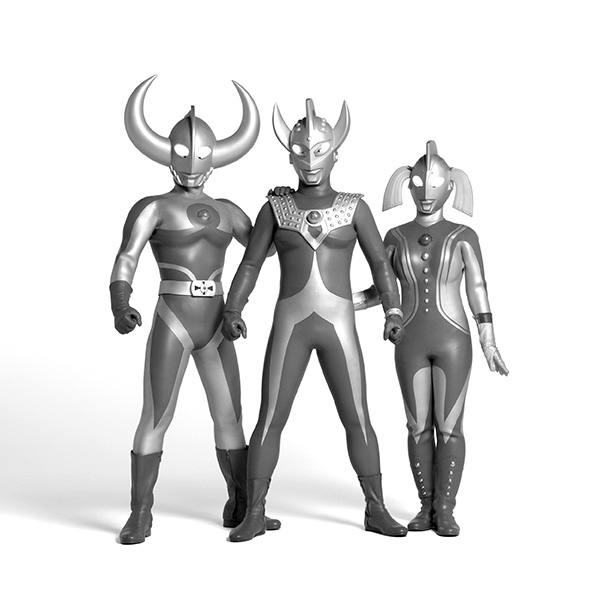
Tsuburaya Productions Award
- Ultraman Encyclopedia & Picture Book Set (6 Books)
“No matter how many times I told you, you couldn’t remember umineko, ‘sea cat,’ the name of that seabird. Then, just to try it, I taught you umiinu, ‘sea dog,’ and you learned it in one go!”
My mother bursts out laughing as she tells this story.
Whenever the opportunity comes up, again and again.
It’s embarrassing.
Why keep talking about things from when I was little, even after I’ve grown up?
That was what I used to think.
Time passed, and I had two children.
At two, my son became completely hooked on Ultraman.
Ultraseven was his particular favorite.
He loved it enough to sing the opening theme:
“Seven! Seven! Seven! Dan Moroboshi’s…”
His signature pose: “Shuwatch!” A beam attack.
But listening closely, I realized he was saying “Ultomaran.” I corrected him a few times, but it was still “Ultomaran.”
Yes, yes. How cute, I thought, and stopped correcting him. Before I knew it, he was six. He no longer said “Ultomaran.”
My daughter, now two, loves Anpanman, the hero who stands for justice.
One day, as we were about to go for a walk, it happened.
“Mommy forgot to lock the door! Wait a moment.”
“Lock?”
“We need to lock it. It would be terrible if a burglar came into the house!”
“Dobo, doboro, Mr. Doboro!”
She was trying to say dorobo, the Japanese word for burglar. I will never forget her radiant “I said it!” smile.
“It’s okay! I’ll beat Mr. Doboro with a punch!”
How dependable.
Just what you would expect from a daughter who looks up to Anpanman.
She had thought so hard, and was utterly sure: That’s it!
Too cute for words.
Will this “Mr. Doboro” disappear someday, too?
Surely, inside my mother, the little me of those days remains just as vivid.
When she tells my mispronunciation stories over and over, perhaps she is not only teasing me, but also cherishing the child I used to be.
Surely, I, too, will remember for a long, long time. As treasured memories of life with my children.
Along with those words, the images of my two-year-olds come vividly back.
“Ultomaran.” “Mr. Doboro.”
My children, shining as they said them.
Surely, when I managed to say “sea dog,” I must have had the most wonderful smile, too.
Lingua Franca NY Award
- Lingua Franca NY Branded Original Products
After my father became hard of hearing, subtitles began to multiply at home.
He turned up the television and began calling my mother when the phone rang. More often, he laughed a little after the rest of us. Whenever he was left outside the conversation, my mother repeated what had been said, and he pretended to understand. I found it hard to watch him laugh that way.
My mother wrote in thick letters on the backs of advertisements and stuck the notes on the refrigerator and around the television.
“Your meal is in the fridge.”
“Hospital at three.”
“Medicine taken.”
At first, she repeated the same things over and over. Gradually, though, she said less: “Oh, it’s quicker to write it down.” My father read silently and, once a note had served its purpose, folded it into quarters.
I live away from home. When I returned after a long absence, the house was full of reminders. It felt like a house that had given up on conversation, and made me a little sad.
During dinner, when I talked about work, my father asked me to repeat myself three times. By the third time, I was tired of it, too. I put down my chopsticks and wrote on a scrap of paper nearby, “I’m still just drawing plans.”
My father put on his glasses and read slowly.
“I see. When will one of your buildings go up?”
So he wouldn’t have to ask again this time, I answered loudly, “Not for a while yet.” My mother laughed. “You heard that, then.” My father laughed, too.
The next morning, as I was about to leave, my father handed me a small folded piece of paper. It was the one I had written on the night before.
On the back, in his handwriting, were the words “When it’s built, I’ll go and see it.”
“You could have just said that.”
When I said this, he pretended not to hear.
At the front door, underneath his words, I added, “Then live a long time.”
He read it for a while, then tucked the paper into his wallet.
In the house where subtitles had multiplied, so had words we could not throw away.
Oyakoday Award
- Oyakoday Original Goods
During summer vacation, I took my two elementary-school children home to visit my parents.
“Wait! Aren’t these the spoon and fork I used when I was in kindergarten?”
They had been set out on the table for my eight-year-old daughter. It must have been about thirty-five years ago that I used them at home. They were decorated with characters from a cartoon I loved back then, and on the back was my full name, written in hiragana. Seeing my maiden name felt somehow as though it belonged to someone else.
Mom, how much stuff can you possibly hang on to? I thought. Yet this unexpected reunion brought a rush of surprise and nostalgia.
My parents, my two children, and I gathered around the table. It seats four, so there weren’t enough chairs. I took the piano bench and sat at the head of the table.
“I’ve started clearing things out lately. I sold the stereo, too,” said my father, who turns eighty this year. That enormous stereo had occupied the living room for years. Apparently, after retiring, he used to spend his days listening to music with the cat.
But last year the cat died, aged eighteen.
And now the stereo was gone, too.
While I was away, the familiar scenery of home had been changing, little by little.
Someday, this house and this table would probably disappear as well.
Knowing that, however, did not change anything I did.
As always, I left everything to my mother, from clearing the dishes to washing her grandchildren’s clothes. She did it all as though it were the most natural thing in the world, fussing over me, her daughter: “I’ve got a toothbrush ready for you,” or “The bath is ready.” I let myself be spoiled. Even when I tried to help, she smiled and said, “It’s fine. Just sit down.”
No matter how many years pass, I am my parents’ child.
I have given birth to two children and become a mother, but when I go home, I am a child.
Amid the slowly changing scenery of my parents’ house, a thought came to me.
As their child, what can I do with the time we have left?
Probably nothing special.
I will come home again with their grandchildren, and let them welcome me with “You’re home.”
Perhaps that alone is enough.
Every day, Masaharu Fukuyama’s “Sakurazaka” played in my father’s hospital room.
It was a song my mother had loved, and the nurses played it each day on a radio-cassette player. The singing slowly filled the quiet room. My father listened with his eyes closed, and I pulled a chair close beside him. For those few minutes, even the sound of the ventilator seemed to fade into the distance.
My father had emphysema and could no longer eat as he wished.
Once a week, on my way to the hospital, I stopped at a sushi shop.
“Just one piece, please.”
I would have them wrap up a piece of the nigiri sushi my father loved.
When I received the package, I cradled it gently against my chest so it wouldn’t fall apart. As I walked the short distance to his room, I had only one wish: that he might smile today.
I cut it into small pieces and brought them to his mouth. He chewed slowly. With his eyes closed, he savored the taste, let out a little breath, and softened the corners of his eyes ever so slightly. Whenever I saw that expression, the father who used to take us out for conveyor-belt sushi on days off came back to me.
In truth, I hesitated. I knew better than anyone that even that mouthful could be a strain on him. Still, that day I wanted him to eat something he loved.
One day, he took my right hand and gave a small nod. He said nothing. His hand had grown thin, but it held exactly the same warmth as the hand that had gripped mine firmly when I was little and about to fall.
In time, my father quietly passed away. I was the last person to leave his room. Even on that final day, I could not take off my white coat.
Twenty-four years have passed. Whenever I hear “Sakurazaka,” I return to that hospital room. Whenever I pass a sushi shop, I stop. Standing before the display case, I still find myself remembering the words I said that day.
“Just one piece, please.”
That ordinary little request at the sushi shop marked the beginning of time spent facing my father. Even now, whenever I remember those words, I become once again the son carrying a single piece of sushi to him.
Sunday mornings in our house meant pancakes made by my father. Whether I had scored full marks on a test or lost a match with my school club, that never changed.
My father was a man of few words. In my rebellious years, I wouldn’t answer even when he spoke to me. Still, he went into the kitchen without a word. The sound of the spatula touching the plate, the smell of melting butter. Without meeting my eyes, he stacked the slightly scorched rounds one after another. Finally, he jerked his chin toward me. That was his signal to eat.
Even the weekend I argued with my mother about which high school to attend and shut myself in my room, there was a plate outside the door. Slightly misshapen pancakes drizzled with maple syrup. Stubborn as I was, at first I wouldn’t eat them. But when I finally took a bite, there was a faint saltiness beneath the sweetness. Somehow, that taste loosened the tightness in my chest.
One day, my mother told me with a smile that my father was no good at cooking. Apparently, on the day I was born, he had said, “I want to make these for this child when they’re older,” and practiced making pancakes, failing over and over.
I had always thought love was something you expressed in words. But my father held a frying pan instead. As his fingertips checked how brown the pancakes were, he put his feelings for me into them. The batter he turned over and over that morning must have held so much time I knew nothing about. Even a burnt pancake was not a failure, but proof that he had been thinking of me. Now I understand that this awkwardness was his own way of loving me. I will not forget that love.
After leaving home, I tried making pancakes myself for the first time. But they didn’t taste like his. Even the faintly burnt smell was part of a flavor only my father could make.
Next time I go home, I will cook them. I probably won’t do it well. I may burn them a little. Still, I have a feeling Dad will eat them without a word.
This time, I want to give back what he gave me that day. To put my thank-you into a freshly made pancake.
One day after I became pregnant and received my maternal and child health handbook, I needed to check my vaccination history. I asked my mother, “Could you show me the handbook you kept for me?” Looking a little shy, she brought it out and said, “I still have it.” The moment I held that well-thumbed handbook, I felt as though I had also been handed all the time during which I had been lovingly protected, from when I was still in her womb.
Turning the pages, I found not only vaccination and checkup records, but a page called “Things Yukika Said.”
There, one by one, she had carefully recorded my first words and the endearing mistakes I made when I was little.
“Spaghetti” was “skabekki.”
I couldn’t help smiling at the thought that she had written down even such an ordinary little word. At the same time, my heart grew full as I realized that the unremarkable days I no longer remembered had been irreplaceable treasures to her.
Until then, I had thought of the handbook as a place to record a child’s growth and health. But looking at the one my mother had kept, I realized that this single volume held all the love of a mother who rejoiced in her child’s growth and tried to preserve every moment.
Soon, I will be a mother, too.
I want to carefully write down my own child’s first words, the little mistakes that make me laugh, and the growth and memories of each stage. And someday, when this child becomes a parent, if we can open the handbook together and laugh as I say, “This is what you used to say,” I could ask for no greater happiness.
The “Things Yukika Said” my mother kept showed me that I had grown up loved. And that handbook has become a precious volume that gently, tenderly encourages me as I prepare to become a mother myself.
At a dead end with raising my first child, I grasped at a straw and asked generative AI, “How should I deal with a child who won’t listen?”
Within seconds, the screen displayed the very model answers you would find in a parenting book: “First, acknowledge your child’s emotions,” and “It is important for the parent to take deep breaths.”
Certainly, it was sound advice. But exhausted in front of my screaming child, I found those “perfect answers” all the more suffocating. I felt accused: If you can’t do that, you’re the one at fault.
Suddenly, I wondered what my mother back home would say.
“Just let the child cry. You sit there and have a snack.” “Children do better when their parents don’t try so hard.”
Normally, I would snap, “But that’s cruel!” and it would inevitably turn into a fight. Yet, strangely, now that I felt about to be crushed by the right answers, my mother’s easygoing, rather careless attitude felt warm.
Rough-edged, slapdash advice that an always-correct AI could never give. Sometimes, it is precisely that broad, untidy permission—the kind I occasionally resist—that saves me.
I closed the cold screen listing all the right things and took a fresh grip on my smartphone. Every so often, even at the risk of an argument, I think I should listen to the voice of that easygoing, rather careless woman who has done this before me.
“I am not loved…”
I had felt that way ever since I was little.
My family ran an udon shop. I was woken while it was still dark outside and made to tread the noodle dough with bare feet. In winter my feet were cold, and although the dough was soft, it was springy and would not yield the way I wanted. I kept treading for an hour until it developed the right firmness, worn out before the day had even begun. My mother and grandmother finished the dough my brother and I had worked.
What I really wanted to say was, “I wanted to stay asleep…” But I couldn’t.
Every morning, without being asked, I cleaned the shop by myself. Still, my mother would not give me so much as a smile. As I cleaned, she always threw the same words at my back.
“Those who don’t work don’t eat.”
I tried so hard because I wanted praise, but that one remark was all I got. I just wanted to hear, “Thank you. You did well.”
Afraid of being disliked, I silently endured things I hated. Whenever I saw friends laughing with their mothers, I thought, It isn’t like that in our house.
Mom, do you dislike me…?
I grew up with that question tucked away in my heart. I wrote the feelings I could never say aloud in a letter, and had my mother read it in her room.
She told me she had thought I was “not lovable” and had not been able to see me as her daughter. Then she went on,
“You’re still going on about something that long ago? You really hold a grudge.”
“What? What is that supposed to mean? That’s what you thought…?”
Sadness and anger welled up, but I couldn’t understand how she could say such things. In the end, only emptiness remained.
My mother has always been like a great wall. I am grateful that she gave birth to me and raised me.
But whether I can love her, whether I can forgive her, is another matter. I think that will still take time.
Every parent–child relationship has its own shape. What I learned from my mother was not to blame myself for my feelings.
Because those feelings are part of me, too.
When I remember my father as a young man, the memory begins with a large yellow pickling barrel.
In Saku City, Nagano Prefecture, where I was born, neighbors once used to gather to pickle nozawana greens. On winter mornings when diamond dust shimmered in the air, children would come to our house, whose turn it was to host, their white breath puffing excitedly.
“It’s about time.”
My father, who had been drinking since morning, sprang to his feet.
Children gathered for this event because they had the special privilege of getting inside the barrels for a little while. One year, my older brother and sister tried to copy the adults and put little me into a barrel, but they weren’t strong enough and knocked me over, barrel and all. Dad effortlessly scooped up my crying body, put me into the barrel, and gently closed the lid.
It was a secret hideout. Walls glowing faintly yellow. The adults’ endless chatter coming slightly muffled from outside. And the sharp smell of nozawana that no amount of washing could remove… I soon stopped crying and kept swallowing hard.
Eventually, the elderly master pickler arrived, and the children were plucked from the barrels like nozawana growing in a field. In our place went great armfuls of greens and salt. The sight of my father’s back as he worked so skillfully looked wonderfully impressive to me.
“…A little while after that, the expert died, and that was the end of the gathering.”
When my children and I came home from Toyama for the New Year holidays, Dad ate store-bought nozawana as he told his grandchildren how that now-vanished custom had ended.
“Hey, Grandpa. Let’s do it at our house again. Pickle nozawana.”
“Grandpa can’t anymore. It’s heavy, you know. Hard work. But the nozawana back then was so good…”
My father had bile duct cancer. The chopsticks in his hand trembled slightly.
Three months later. The Hokuriku Expressway was a little crowded during spring vacation. An hour and a half remained before we reached the family home where Dad was waiting.
“I can’t wait for Grandpa in Nagano to try the nozawana we pickled.”
Inside the car came my daughter’s bright voice… and the rattling of a small yellow pickling barrel as it swayed.
After graduating from high school, I was going to start living on my own.
On the morning of the move, my mother was just as usual.
“Have you forgotten anything?”
“No.”
“Are you sure?”
“I’m sure.”
Being asked over and over began to feel a little tiresome.
At the entrance, I put on my shoes and turned around.
As always, my mother said, “Take care.”
“Well, I’m off.”
With that, I left the house.
On my way to the station, my smartphone chimed.
It was my mother.
“Make sure you eat breakfast.”
I couldn’t help laughing.
We had been together just a moment ago.
“I know.”
When I sent that reply, an answer came immediately.
“Itterasshai—see you when you’re home.”
The usual words.
But for the first time that day, I realized something.
“Itterasshai” is something you say to someone who will come back.
So focused on leaving home, I had forgotten that I had a place to return to someday.
However many years pass, whenever I leave my parents’ house, my mother always says, “Take care.”
I always answer, “Ittekimasu—I’m off, and I’ll be back.”
Just two expressions.
Yet between them are all the time we have spent together and the promise that I may keep coming home.
As parent and child, we need no special words.
Today, too, at someone’s front door somewhere,
“I’m off.”
“See you when you’re home.”
Such ordinary exchanges are making the stories of parents and children.
Special Mention
- Oyakoday Original Goods
In my house, whether to eat dinner is not a matter of choice.
Every evening before eight, my mother calls the whole family to the table in the same firm voice. It doesn’t matter if homework is waiting. Phone notifications can wait. Even the worst of moods can wait.
Dinner comes before everything else.
When I was little, I thought this rule was terribly unfair.
My friends ate wherever they liked: on their beds, in front of the television, sometimes without speaking to anyone at all. Yet in our house, every single night, everyone had to sit down properly together. As though attendance were compulsory.
And my mother took that responsibility very seriously.
If my older brother was late, she called his name from the kitchen again and again until he finally appeared. He arrived looking like someone who had been summoned to court. If I so much as tried to check my phone under the table, she noticed immediately.
“Aqila,” she would say. “Your phone won’t starve. Your dinner will.”
At times like that, my father was usually sitting quietly at the table. After a long day at work, his face looked serious.
Yet there was one thing that could instantly soften the expression of my father, however calm and composed he might appear.
Telur dadar bawang.
An onion omelet.
The moment it appeared on the table, his expression changed almost immediately. He reached for it with such astonishing speed that sometimes the ensuing arguments were so dramatic they might have been negotiations in an international dispute.
“Dad, you took the biggest piece again!”
My mother sighed. My brother protested. I complained loudly.
And so dinner went on in exactly the same way every night.
Noisy, ordinary, repetitive.
At thirteen, I thought such ordinary things meant nothing.
I liked achieving things. I liked orderly systems. I liked efficiency. I thought meaningful moments had to be special.
Sitting around the same table every night seemed like nothing more than a routine I would outgrow someday.
Then, one evening, my father came home very late.
The rice had already gone cold. The soup no longer steamed. Even the onion omelet sat untouched in the middle of the table.
“Let’s just eat without him.”
After a while, my brother said it.
But my mother shook her head.
Instead, without a word, she reheated all the food.
For the second time that evening.
Then a third.
She pretended to concentrate on her work in the kitchen, but her eyes kept returning to the clock on the wall.
For the first time, our dining table felt incomplete.
The room was the same as always. The plates were neatly arranged. The food was there.
Yet something important was missing.
At last, the front door opened and my father came in, looking more tired than I had ever seen him. His shoulders seemed heavier than usual, as though the whole weight of the world outside had been placed on them before he was sent home.
No one complained about having to wait.
No one mentioned the time.
My mother simply stood up, reheated the soup once more, and placed a warm onion omelet on his plate.
Without a word.
In that quiet, almost unnoticeable moment, I understood something I had failed to see for years.
This table was not only a place to eat.
It was a place to return to.
Every day, the world pulls people a little farther apart.
Work tires them. School distracts them. Phones steal their time. Pride silences them. Time carries them ever onward before they notice.
Yet amid all of it, my mother was protecting a small place where we could still belong to one another.
Not through grand speeches.
Not through perfect family moments.
Through something much simpler, and far more difficult.
Keeping it going.
The same table. The same chairs. The familiar voices of our family overlapping every night.
I used to think love was dramatic. Unforgettable. Like something in a film.
But now I think the deepest love may take a form so ordinary it is almost embarrassing.
Like my mother’s voice from the kitchen calling my brother’s name for the fifth time.
Like my father silently reaching for a second piece of onion omelet at the end of an exhausting day.
Like a conversation that moves from school grades to silly gossip in less than five minutes.
And perhaps love is simply this.
All of us waiting for someone in the family to come home.
Because someday, not every chair around our dining table will have a family member in it.
Conversations will become memories.
Laughter will remain only in fragments replayed in our minds.
And someday, far into the future, I will remember my mother’s voice calling us to dinner more clearly than any achievement I have ever earned.
Not because dinner itself was special.
But because that quiet time, repeated over and over, taught me what “home” really means.
Participation Awards
In addition to the works announced above, we received many essays sharing cherished memories and heartfelt reflections. We also received numerous entries from schools and classes that took part together in the Oyako Day Essay Contest. Although these entries were not selected for awards, we sent participation gifts to each participating high school as a token of our appreciation and in the hope that they will continue to take part in the years ahead.